
Removing old garage floor and driveway paint before a fresh start
We remove peeling paint, flaking coatings and failing sealer from outdoor driveways, carports, patios and communal garage floors so a new coating has something sound to grip. Loose material comes off under controlled pressure; paint that is still firmly bonded is assessed on site rather than attacked blindly.
Send us a photo and the m²Why does old paint on a driveway peel in the first place?
Paint on a driveway usually peels because it did not bond properly to the concrete underneath. The most common reasons are a dirty or dusty surface when it was applied, oil left in the pores, moisture coming up through the slab, or a coating that was not suitable for vehicle traffic.
Once a coating starts to lift at one spot, water gets underneath and the edges keep curling. Tyres turning on the surface then tear off more flakes, which is why peeling often starts where cars park and turn.
Our guide on removing old paint from outdoor concrete explains the typical causes in more depth and what they mean for the next coat.
What can be stripped with a pressure washer, and what cannot?
A pressure washer removes paint that is already loose, blistered or poorly bonded; it does not reliably remove paint that is still firmly stuck to the concrete. That distinction decides how a job is planned.
| Condition of the old coating | What usually happens |
|---|---|
| Flaking, curling at the edges, powdery | Comes away with a controlled wash |
| Blistered or bubbled | Blisters open and lift; surrounding paint is checked |
| Patchy: some areas loose, others firm | Loose areas come off; firm areas are assessed |
| Firmly bonded across the whole surface | Generally stays; may serve as a base if compatible |
| Old sealer on imprinted concrete gone white or milky | Damaged layer often lifts or is reduced; tested first |
Whether firmly bonded paint can stay under a new coating depends on compatibility between the old and new products, as set out on the product data sheet. Where that is unclear, we explain the options instead of guessing.
How do we prepare a painted surface for a new coat?
Preparation starts with removing everything that is not sound, then cleaning what is left, then repairing the concrete that the stripping reveals.
- Test the old coating at several points to see how well it is bonded.
- Pressure wash to lift loose paint, flakes and failing sealer.
- Collect paint flakes and solid residue rather than washing them into drains.
- Treat oil or growth that the old paint was hiding.
- Repair cracks, small holes and chipped edges on the clean surface.
- Cut in the edges by brush and apply two coats of synthetic resin paint, if a recolour is part of the job.
Stripping often uncovers cracks that the paint had bridged. That is normal, and it is better to see them before the new coating than after. For a recolour, the cleaning and preparation stage is the same as on unpainted concrete once the loose paint is gone.
Can you strip old sealer from imprinted concrete?
Yes, where the old sealer has failed. Typical signs are a white or milky haze, patchy shine, flaking at the edges or a surface that looks dusty even after rain.
We reduce or remove the damaged layer with controlled washing and test patches. Sealer that is still sound and clear may be left in place, depending on what goes on top. On faded imprinted driveways, the strip can be followed by crack repair and a two-coat recolour; our sister site on faded imprinted concrete shows what that looks like.
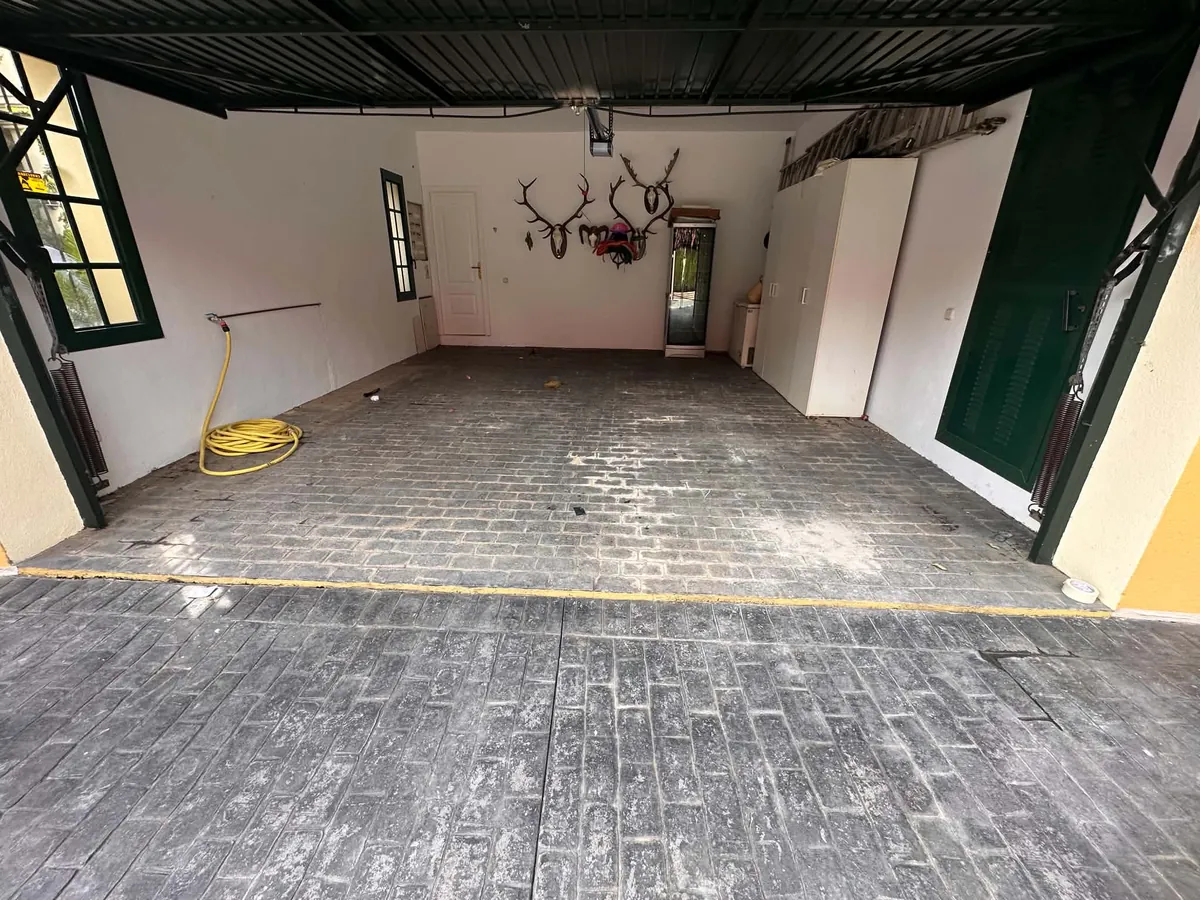
Where do the paint flakes and the wash water go?
Paint flakes and solids should be collected and kept out of drains and the sewer. Málaga city's sanitation regulation bans discharging paints and pigments that normal treatment cannot remove, as well as solids that can obstruct the network.
Rules for other municipalities, including Marbella, have not been verified in official sources (to be verified), so ask your ayuntamiento if you are unsure. Our guide on wash water and residues sets out what we have checked, with links to the official texts.
Which painted surfaces do we strip?
We strip coatings from outdoor hard surfaces and from communal garage floors, not from walls, furniture or interior rooms.
- Painted plain concrete driveways and carports where the colour has worn through in the wheel tracks.
- Garage aprons and ramps where the coating has peeled into flakes and patches.
- Patios and pool surrounds painted years ago with a product that has since chalked or blistered.
- Painted block paving where the colour has come off the tops of the blocks but stays in the joints.
- Imprinted concrete with a failed, whitened sealer.
If your surface is not on this list, send a photo anyway; we will say quickly whether it is something we take on.
What decides the cost of paint removal?
The cost depends on the area, how much of the old coating is loose, how many layers there are, the surface underneath and access. Collecting residues and any repairs the stripping reveals are also part of the picture.
Send photos of the whole surface and close-ups showing the peeling, with the approximate square metres. Orientative prices are on the partner page for pressure washing cost, and the article on what can go wrong with jet washing explains why aggressive stripping can do more harm than good.
Frequently asked questions
Can you remove peeling paint from my patio?
Yes. We lift loose and peeling paint from patios, terraces and pool surrounds with controlled pressure washing, then clean the surface underneath. Paint that is still firmly bonded is tested and discussed with you, because it may be better to leave it as a base than to damage the concrete removing it.
Will all the old paint come off?
Not necessarily. Loose and poorly bonded paint comes off; paint that is firmly stuck often stays. Whether it can remain under a new coating depends on compatibility according to the product data sheets. We tell you before starting what we expect.
Do you use chemical paint strippers?
Our main method is controlled pressure washing combined with testing. We do not recommend specific products, and if a particular coating needs a different approach we explain it and agree it with you before doing anything, including how residues are handled.
Can you remove old garage floor paint indoors?
We do not work on indoor residential floors. We do work on outdoor driveways, carports and garage aprons, and on communal garage floors and ramps managed by a community of owners. Send photos and we confirm whether your garage fits.
Why did the previous paint on my driveway fail?
Common reasons are poor cleaning before painting, oil left in the concrete, moisture rising through the slab, a coating not designed for vehicles, or a single thin coat. Removing the old layer often shows which cause applied, which helps avoid repeating it.
Can the white haze on my imprinted concrete be removed?
A white or milky haze is usually failed sealer. It can often be reduced or removed by controlled washing, which we test on a small area first. If the colour underneath has faded, a recolour is the way to bring back an even look.
Will stripping damage my concrete?
Excessive pressure can erode the surface of weak or old concrete. That is why we test first and use settings matched to the surface. If the concrete itself turns out to be weak, we stop and discuss repair options before continuing.
Do you paint parking lines after stripping a garage floor?
No. We do not mark or number parking bays. We can strip, clean, repair and recolour the floor surface, and the community can arrange line marking with a specialist afterwards. We can tell the administrator when the coating is ready according to the product data sheet.
Can you remove paint in Estepona or Mijas?
Yes, we work along the coast including Estepona, Mijas, Fuengirola and Benalmádena, as well as inland. Rules on wash water and residues vary by municipality and are not verified for most towns, so check with your ayuntamiento if the job is large.
Is it better to strip everything or paint over the old coat?
It depends on how well the old coat is bonded and whether the new product is compatible with it. Loose paint must always go. A firmly bonded, compatible coat can sometimes stay. We assess this on site rather than giving a general rule.
Related articles

What really affects the cost of jet washing a driveway or patio?
The cost of jet washing depends on six things: the area, the type and depth of soiling, the stains that need targeted treatment, the material, the access and what happens…

Will pressure washing damage my paving? The concerns owners raise before booking
Pressure washing can damage paving if it is done with the wrong pressure, angle or distance, but a careful, tested approach keeps that risk low. The main concerns to cons…

What can go wrong with jet washing, and how to avoid it
Most things that go wrong with jet washing come from too much pressure, too little preparation or no plan for stains and residues. The typical results are stripes, emptie…

Cleaning or recolouring: what does your driveway really need?
If the colour is still there under the dirt, cleaning is enough; if the concrete has faded, cracked or lost its finish, cleaning is only the first step before repairs and…

Who professional pressure washing is for, and who should look elsewhere
Professional pressure washing is for owners whose outdoor surfaces are sound but dirty, stained or overgrown, and for anyone preparing a surface for repairs or a new coat…

Removing old paint and failed sealer from outdoor concrete
Old paint on outdoor concrete should be removed wherever it is loose, flaking or blistered, because anything applied on top of it can only be as good as the weakest layer…