
Oil stain removal on driveways, carports and garage floors in Malaga
We treat oil stains on driveways, carports, garage ramps, stamped concrete and patios, and we tell you from your photos how far each stain is likely to fade. Fresh drips often lift well; old stains that have soaked deep into porous concrete may leave a lighter shadow that only a recolour hides.
Send us a photo and the m²Why are oil stains on concrete so hard to remove?
Oil stains are hard to remove because concrete and paving are porous, and oil travels into the pores instead of sitting on top. Dirt can be washed off a surface; oil has to be drawn back out of it.
The longer a stain has been there and the more often it has been topped up by the same car, the deeper it goes. Sun and heat on an open driveway can also make the residue tackier and darker over time.
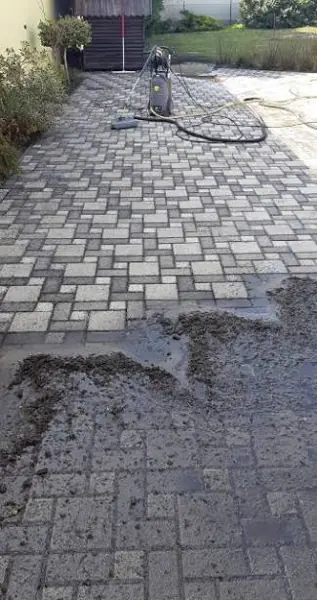
This is why a pressure washer on its own usually only cleans around an oil stain, leaving a sharp dark patch in the middle of a freshly cleaned driveway.
On rental villas this can be very visible, because guests park in the same spot again and again. A single drip line under a hire car can turn into a large dark patch over a season without anyone on site paying attention to it.
Which oil stains come out and which ones leave a shadow?
The outcome depends mainly on the age of the stain, how much oil went in, and how porous and how sealed the surface was when it happened.
| Situation | Typical outcome |
|---|---|
| Recent drips on sealed imprinted concrete | Usually lift well, because the sealer slowed absorption |
| Recent drips on bare concrete or paving | Usually lighten considerably |
| Old, repeatedly topped-up stain under a parking spot | Lightens, but often leaves a shadow |
| Stain that has dried into a crust | Crust removed first, then the stain treated |
| Stain on a surface with failing paint | Paint may come away with the stain and change the picture |
We look closely at your photos before quoting. If we think a stain will leave a visible mark, we say so up front rather than letting you discover it after the work. Our guide on which oil stains come out of concrete goes into the reasons in more detail.
How do we treat an oil stain on a driveway or carport?
We treat oil stains in two stages: a targeted treatment that loosens and draws out the oil, then a controlled pressure wash of the stain and the surrounding area so it blends in.
- Check the surface type, the sealer and the age of the stain.
- Remove any crust or loose residue sitting on top.
- Apply a targeted treatment chosen for that surface, and give it time to work as the product instructions specify.
- Pressure wash the treated stain together with the area around it.
- Assess the result and, where it helps, repeat the treatment once.
Washing the whole surrounding area matters. If only the stain is cleaned, you swap a dark patch for a pale one. Our general pressure washing service covers the full surface so the finish looks even.
Oil stains on imprinted or stamped concrete: anything special?
Yes. Stamped concrete is usually coloured and sealed, and oil and treatments can both affect that sealer. A stain that has softened the sealer may lift together with some of the shine around it.
On faded imprinted driveways, one option is to clean, repair cracks and recolour in two coats of synthetic resin paint, because the new colour covers what is left of the stain and the general wear at the same time. The Marbella carport project shows that sequence from wash to finished colour.

What about oil in garage floors and communal car parks?
Communal garage floors and ramps collect oil from many vehicles at once, usually concentrated in each parking space and along the ramp. The same principles apply, scaled up and organised around residents' cars.
We plan the work by zones with the administrator so residents know when to move their vehicles. The communal garage cleaning page explains how that coordination works and what the community needs to decide.
Oily wash water should not go into the sewer. Málaga city's sanitation regulation bans discharging several oily and solvent-type substances, and our guide on wash water and residues explains what is verified and what you should confirm with your ayuntamiento.
How can you stop new oil stains after cleaning?
The simplest prevention is to deal with the source: a car or motorbike that drips will keep marking the same spot. A drip tray or mat under a regularly parked vehicle also keeps fresh oil off the surface.
Fresh spills are far easier to deal with than old ones, so wiping up a drip the day you notice it helps. If you are recolouring, a sealed, coated surface also slows down absorption compared with bare concrete, within the limits described on the product data sheet.
For a price, send photos of each stain and of the whole driveway or garage, with the approximate area. Orientative figures are on the partner page for pressure washing cost, and the article on what affects jet washing cost explains why stain treatment is quoted separately.
Frequently asked questions
Can you remove oil stains from my driveway in Marbella?
Yes. We are based in Marbella and treat oil stains on driveways, carports and garage aprons across the area, including Nueva Andalucía, San Pedro de Alcántara, Elviria and Las Chapas. Send close-ups of the stains and a wider shot of the driveway for an assessment.
Will the stain disappear completely?
Not always. Fresh or shallow stains often lift very well. Old stains that have soaked deep into porous concrete, especially under a regular parking spot, may fade to a shadow. We give you our honest expectation from the photos before you decide.
Can I just pressure wash an oil stain myself?
A pressure washer alone usually cleans around the stain rather than removing it, which can make the dark patch stand out more. We do not give step-by-step DIY instructions, but it is worth knowing that water alone rarely shifts absorbed oil.
Do you remove oil stains from block paving?
Yes. Block paving is porous and the joints can hold oil too. We treat the stained blocks and wash the surrounding area so it blends in, taking care not to empty the joints. Badly soaked individual blocks may remain darker than the rest.
Do you remove oil stains in Fuengirola, Benalmádena or Torremolinos?
Yes, we work along the whole coast, including Fuengirola, Benalmádena and Torremolinos, as well as Málaga city. For communal garages we coordinate with the administrator; for private homes we arrange access directly with you or your key holder. Close-up photos speed things up.
Is it worth treating oil stains before painting a driveway?
It is essential. Oil left in the pores can prevent a new coating from bonding and may show through or cause peeling later. That is why stain treatment and cleaning come before crack repair and the two coats of colour in our renovations.
Can you remove tyre marks as well?
Tyre marks on concrete and paving usually respond well to a careful clean, especially on lighter surfaces. Marks that have discoloured a coating rather than sitting on top of it may remain fainter. We assess them from photos along with any oil stains.
Do you deal with diesel and fuel stains?
Fuel and diesel drips behave in a similar way to engine oil: they soak into porous surfaces and can soften sealers. We treat them with the same two-stage approach and give you the same honest view of what to expect.
What do you do with the oily water?
We plan where the wash water goes before we start and avoid sending oily residues into drains. Málaga city's sanitation rules ban discharging several oily and solvent-type substances; rules for other municipalities are not verified, so check with your ayuntamiento.
How do I get a quote for oil stain removal?
Send a close-up of each stain, a wide photo of the whole area, the approximate square metres and your town. Tell us roughly how old the stains are if you know. We reply with what we expect and a quote.
Related articles
What really affects the cost of jet washing a driveway or patio?
The cost of jet washing depends on six things: the area, the type and depth of soiling, the stains that need targeted treatment, the material, the access and what happens…

What can go wrong with jet washing, and how to avoid it
Most things that go wrong with jet washing come from too much pressure, too little preparation or no plan for stains and residues. The typical results are stripes, emptie…
DIY pressure washer or professional cleaning: an honest comparison
A DIY pressure wash can work on a small, simple, sound surface with ordinary dirt. A professional clean makes more sense on larger areas, delicate materials, block paving…

What it is like to work with us, from first photo to clean surface
Working with us starts with a few photos and an approximate area, and ends with you seeing the clean surface on site or in pictures. In between come an honest assessment,…

Checklist for choosing a pressure washing company you can trust
A good pressure washing company tells you what it will and will not achieve before it starts, tests the surface first, treats stains rather than blasting them, protects j…

How professional pressure washing works on driveways, patios and paving
Professional pressure washing is a sequence, not a single blast of water: assess the surface, test a small patch, clean in a controlled pattern, treat stubborn stains, ri…