
Cleaning or recolouring: what does your driveway really need?
If the colour is still there under the dirt, cleaning is enough; if the concrete has faded, cracked or lost its finish, cleaning is only the first step before repairs and a recolour. The quickest test is to wet a small patch with plain water: a deep, even colour when wet points to dirt, a pale patchy one points to fading.
Send us a photo and the m²How can you tell whether your surface is dirty or faded?
You can usually tell by comparing a wetted patch with the dry surface around it, and by looking at protected spots such as under a plant pot or along the base of a wall.
| Sign | Points to dirt | Points to fading |
|---|---|---|
| Small patch wetted with water | Colour deepens and looks right | Still pale and patchy |
| Area under a pot or mat | Much brighter than the rest | Similar to the rest |
| Texture | Film or growth on top | Chalky, rough, no shine |
| Pattern | Darker in shade, along edges | Paler in full sun, in wheel tracks |
If the signs are mixed, which is common, you have both: dirt on top of a surface that has also faded. A clean will improve it, but not all the way.
What does cleaning achieve on its own?
Cleaning on its own removes grime, organic growth, loose material and much staining, and brings back whatever colour and finish remain. It keeps the original look of the surface, which you may prefer.
It does not restore bleached colour, fill cracks or replace a failed sealer. On those surfaces, a clean gives an honest picture of the condition rather than a finished result. See the patio and driveway cleaning service for what is included.
For owners who rent out their villa, a clean is also the quicker option to organise between bookings, while a recolour needs the area kept free of traffic for as long as the product data sheet requires. That practical difference sometimes decides the timing even when both routes are on the table.
What does a recolour add?
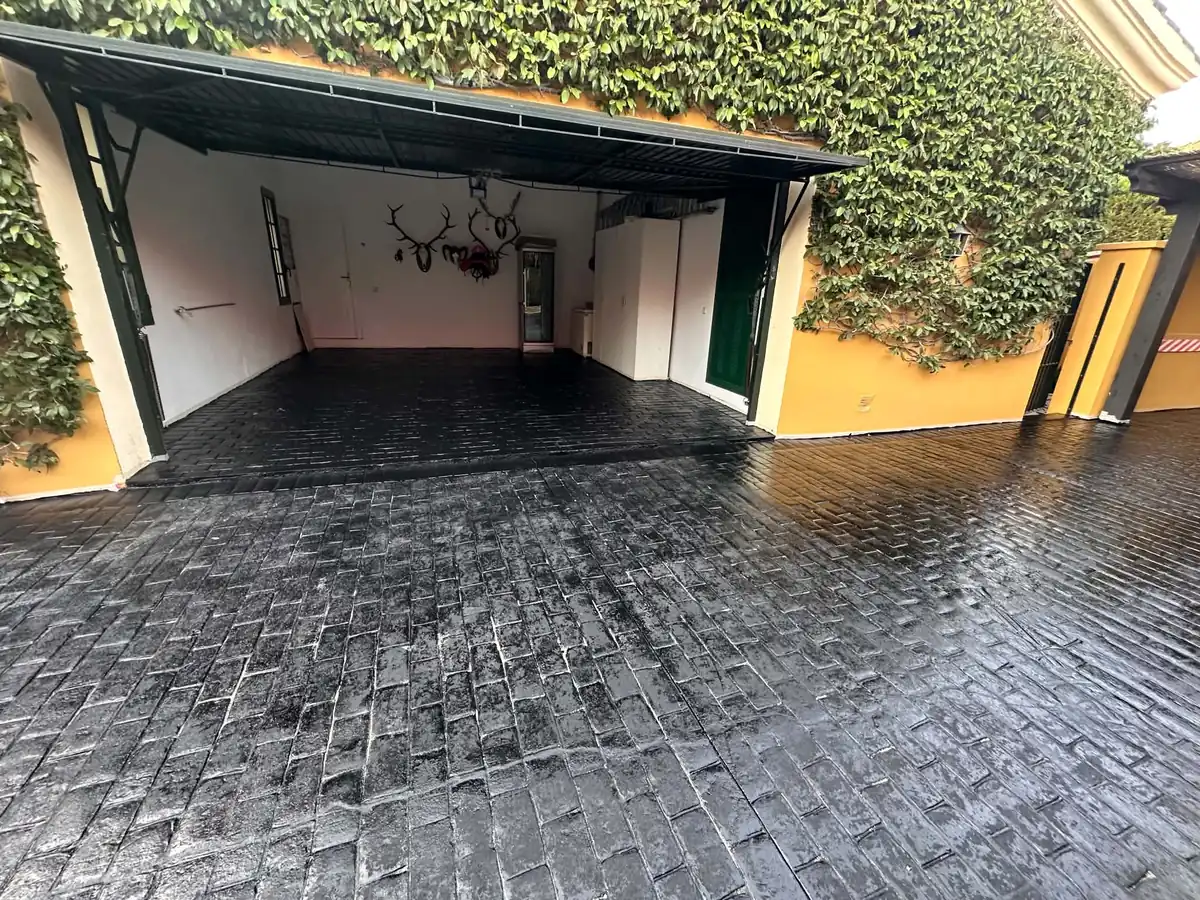
A recolour adds a new, even colour and finish over a surface that has been cleaned and repaired. In our renovations that means cracks and small holes repaired, edges cut in by brush along walls and posts, and two coats of synthetic resin paint.
On faded stamped concrete the change is from dull and patchy to deep and uniform, without lifting the existing surface and without rubble. The Marbella project shows a driveway, carport and garage apron going through exactly that sequence.
Is a recolour ever the wrong choice?
A recolour is the wrong choice when the surface is sound and just dirty, because you would be paying to change something that a clean would have restored. It is also the wrong choice when the ground has moved.
Painting imprinted concrete does not fix subsidence: if the ground underneath is moving, that has to be solved first. Sunken areas, rocking slabs and wide, active cracks are matters for a builder, not for a coat of paint.
How do stains and old paint affect the choice?
Oil shadows and faint rust marks that remain after treatment are often what tips owners towards a recolour, because a new coat covers them. But oil must be treated before painting, or it will undermine the new coating.
If the surface was painted before and is peeling, the loose paint has to come off whichever route you choose; see old paint removal. Rust and growth have their own page on rust, mould and moss.
How do you decide without guessing?
Send daylight photos of each area, one close-up of a patch wetted with water, and the approximate square metres. Tell us whether you prefer to keep the original look or are open to a new colour.
We will tell you which route we think fits, and if cleaning alone will do, we will say so. Our article on whether professional cleaning is worth it covers the cleaning side in more depth, and the partner site on faded imprinted concrete covers the recolour side.
Frequently asked questions
Can I clean now and recolour later?
Yes. Cleaning now improves the look in the meantime. Before a recolour, the surface will need cleaning again as preparation, so if the recolour is planned soon it can be more efficient to do both together. Ask for both options in one quote to compare.
Does recolouring hide oil stains?
A new coat covers the visual mark of a treated stain. The oil must still be treated first, because oil left in the pores can stop the new coating bonding and cause peeling in that spot. Shadows left after treatment are one of the most common reasons owners choose a recolour.
Will a recolour look artificial?
It changes the surface to a single, even tone with a fresh finish. On stamped concrete this often looks close to how it looked when new; on block paving and stone, it changes the natural variation, which some owners prefer to keep.
Is cleaning enough on a driveway that is a bit faded?
If the fading is mild, a clean may make it look good enough for you. The wetted-patch test gives a quick idea. If you are unsure, photos of both dry and wetted areas help us advise. Mild fading on an otherwise sound surface often looks acceptable once the dirt is gone.
Do cracks have to be repaired before a recolour?
Yes. Cracks and small holes are repaired after cleaning and before the colour goes on. Painting over open cracks leaves them visible and lets water in under the new coating. The repair is done on the clean surface so the filler bonds properly. Chipped edges are dealt with at the same stage.
How long does a recolour last?
We do not give a lifespan figure. Durability depends on the product, the preparation, traffic and exposure, and the product data sheet is the reference for what can be expected. Ask any contractor to show you the data sheet for the product they plan to use. Traffic and shade also affect how a finish wears over time.
Can a recolour fix a sunken driveway?
No. Painting does not fix subsidence. If the ground under the driveway is moving, that has to be resolved by a builder before any surface work makes sense. Once the base is sound, the surface can be cleaned and recoloured if you wish. Until then, any coating will crack along with the ground.
Is recolouring possible on block paving?
Yes, after cleaning and dealing with joints and damaged edges. It changes the look of the paving significantly, so it is worth thinking about whether you prefer the natural blocks. Joint and edge repairs come first. Look at examples before deciding, since the change in appearance is considerable.
Does cleaning remove the old sealer?
A careful clean leaves sound sealer in place but may lift sealer that is already failing. That shows you the true state of the surface, which helps decide between cleaning and recolouring. If the shine disappears after cleaning, the sealer was probably already failing.
Can you show me both options on my driveway?
We can describe what each route involves for your surface from photos, and on site we can show you how the surface looks after cleaning a test area before you decide on a recolour. Seeing a cleaned test area next to the rest of the surface is often the clearest way to decide.